Teaching
Sophomore
As the final presentation date approached during my Experimental Physics courses, I recognized my limited presentation skills. Seeing this as an opportunity for personal growth and community contribution, I joined the YongLin Education Foundation as a remedial education teacher at Hope Elementary School.Securing this role involved passing a teaching demonstration interview and participating in a comprehensive three-day workshop to renew the remedial education license for three semesters. The YongLin Education Foundation’s remedial educational program aims to provide educational and financial support to students facing academic challenges due to economic disadvantages.
Engaging with this initiative was a privilege, dedicating two hours per week across two sessions to assist five students. My responsibilities included aiding them in completing homework assignments and addressing gaps in their mathematical understanding. However, the teaching process posed unforeseen challenges. For instance, one student had doctor-confirmed Attention Deficit Hyperactivity Disorder (ADHD). Despite struggling to focus and interrupting frequently, I patiently guided him back to tasks and addressed his math difficulties.Two other students, from families with special occupations, required early sex education and encouragement. Guiding them through these discussions was both challenging and rewarding. Moreover, another student demonstrated significant academic improvement, almost reaching the academic levels of their peers by the conclusion of my one-year engagement.
This teaching experience significantly improved my presentation skills and had a profound impact on my academic journey, providing invaluable practical experience and shaping my approach to education.
Master program:
During my master’s program, I served as a teaching assistant for the Experimental Physics course for two years. Leveraging my prior experience from taking similar courses and my tenure as an undergraduate research assistant, I not only assisted students in solving experiment-related problems but also emphasized the importance of skills for independent research. I eagerly reviewed their weekly previews and reports, providing prompt feedback. I guided them in crafting clear and aesthetically pleasing presentations, addressing experimental challenges they would encounter such as material choosing, component and wires fixation, or experimental environmental management. Often, these issues were not initially apparent to them. Inspired by my advisor’s helpful rehearsal sessions for presentations, I offered to provide similar assistance to my students, a practice adopted by other TAs as well. Witnessing their progress and achievements during the final presentations was highly satisfying. I take pride in the fact that both groups I supervised were ranked first and second as the favorite presentations among high school students. Their thank-you cards often mentioned how my high standards had significantly improved their slide preparation and presentation skills. Despite the time-consuming nature of mentoring and guiding undergraduate students through detailed reviews, I found these experiences highly fulfilling and believe they have contributed to my personal growth.
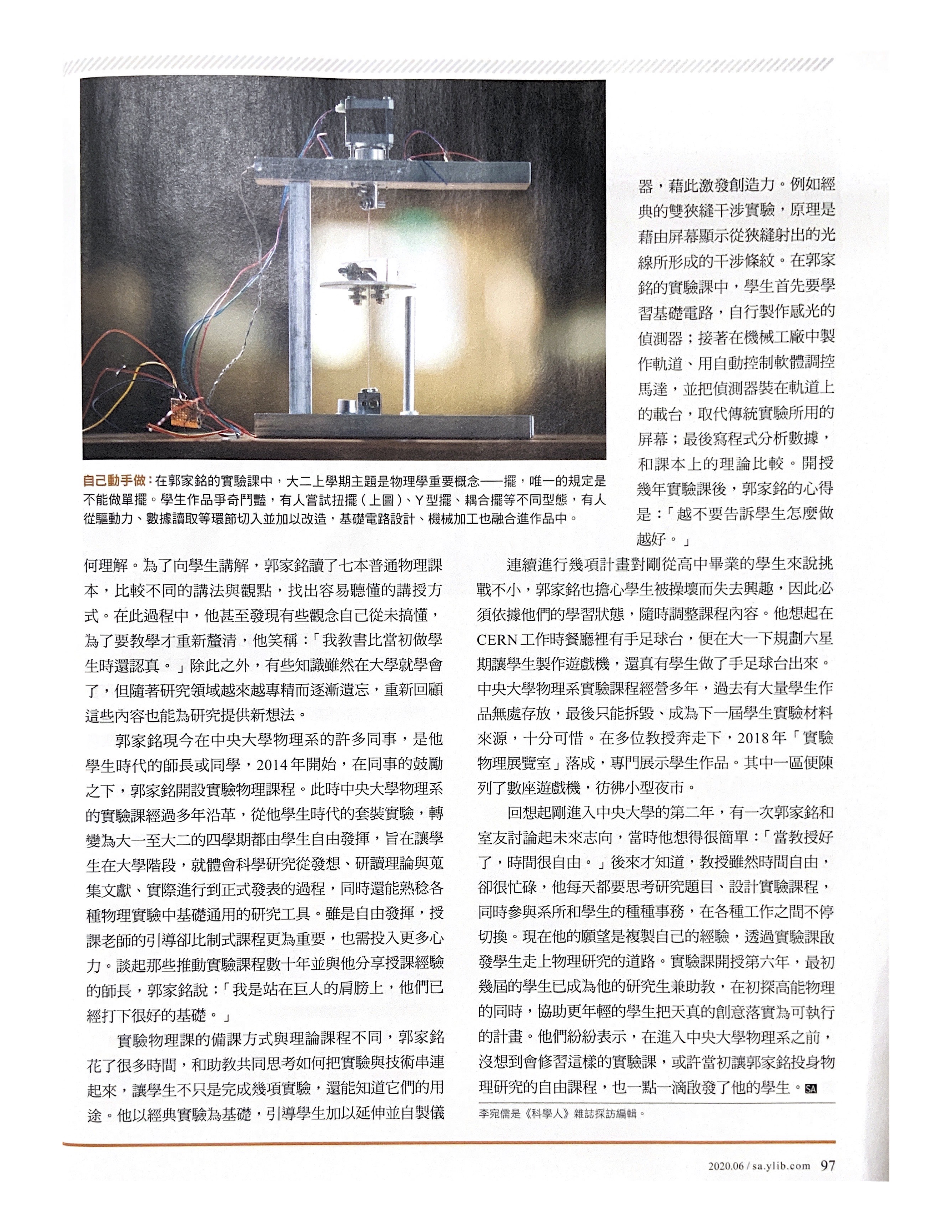
Furthermore, I played a crucial role in supporting students when they faced frustration during their experiments. To ensure that students had ample energy to conduct their projects effectively, we implemented a policy of concluding experiments promptly between 1 p.m and 7 p.m. For any further experimental work, students were required to arrange specific times with their assigned TAs. As the deadline for the final presentations drew near, one of the students under my guidance experienced a sense of urgency and frustration. She was grappling with understanding a particular pattern in her results and was eager to continue her experiment. However, due to the enforced termination of experiments at 7 p.m., she found herself in a difficult situation. In fact, her frustration reached a point where she went to the restroom and began crying, a situation that was brought to my attention by another female student. In response, I decided not to join the other TAs for dinner that evening. Instead, I quickly retrieved a box of tissue paper from our laboratory and positioned myself on a bench outside the laboratory. I waited patiently for her to emerge from the restroom, and for the next hour, I engaged in a heartfelt conversation with her. During our discussion, I conveyed our concerns and provided guidance on where to check in their torsional pendulum experiment. She expressed her deep disappointment with herself for not being able to resolve the issues she encountered. I encouraged her to take detailed notes to avoid forgetting important information and to seek assistance if she encountered challenges that persisted for an extended period. I assured her that I was always available to help with academic questions and invited her to visit our laboratory whenever needed. I also pointed out that I had observed her diligent efforts throughout the project. Ultimately, I advised her to take a break or focus on studying for other tests that night, and we could schedule another appointment to work through the experiment systematically and identify potential issues. As I returned to my dormitory and finally opened my dinner at 12 a.m., I still reflected on how I could further assist with their experiment. Remarkably, her dedication and hard work paid off. She received an Honorable Mention for the Poster Award at the Annual Meeting of the TPS for the same experiment, and a photograph depicting their pendulum was selected for publication in the Chinese version of Scientific American’s June 2020 issue (See the photo below). To my surprise and gratitude, she later expressed her thanks for my encouragement and assistance in a heartfelt card (P10).